REFRACTION
Light bending through a prism.
REFRACTION models the complete signal path of a magnetic-tape echo: pre-emphasis head bump shelf, asymmetric tube-style soft clipper, age filter, worn-head resonance, and independent wow + flutter modulation with band-limited drift. Three independent tape heads tap a single delay line at musical intervals, then a continuous cross-feedback network blends between parallel and ping-pong stereo behaviour. Tape colour sits inside the feedback path, so each repeat truly darkens — exactly how a Roland RE-201 sounds after six passes.
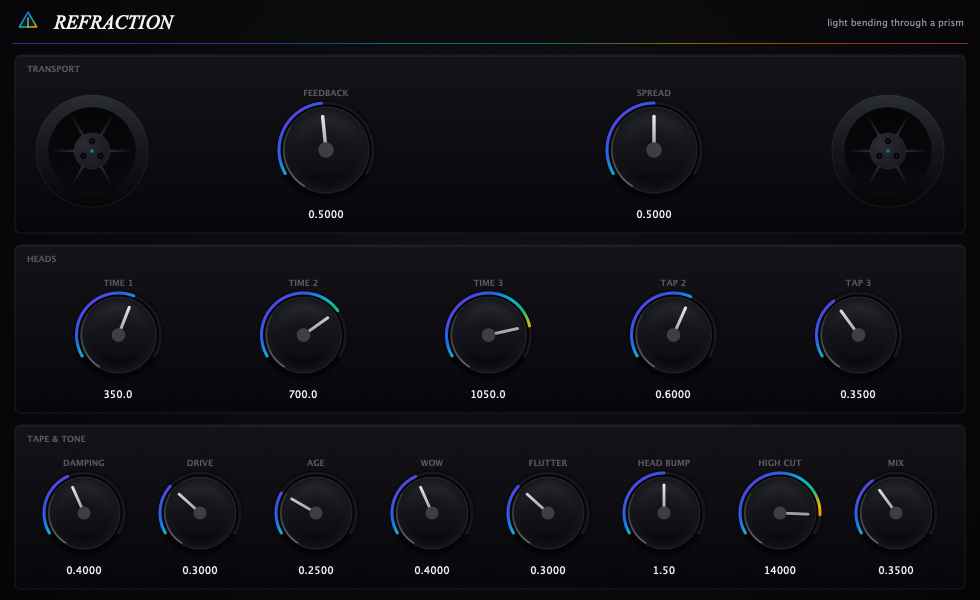
Inside the engine
Architecture that competes with the giants.
Built from the equation up. Every filter, every modulator, every line of signal flow is ours — no off-the-shelf reverbs hidden behind a new face.
Authentic tape model
Head-bump low-shelf at 100 Hz, asymmetric tube saturation (2nd-harmonic forward), age-dependent HF loss and worn-head resonance — modelled per tape pass, not just at the input.
Wow + flutter + drift
Independent wow (0.7 Hz, large depth), flutter (12 Hz, small depth) and a smoothed random drift. Subtle by default, beautifully chaotic at extremes.
Three-head multi-tap
Each tap has independent time (10–2000 ms), level and pan. Build classic slap, dub, dotted, or polyrhythmic patterns from a single delay line.
Continuous ping-pong
SPREAD knob smoothly morphs from parallel-channel feedback (0) to fully crossed ping-pong (1) — no abrupt mode switch.
Plug-in formats
Tested DAWs
- Ableton Live
- Logic Pro
- Pro Tools
- FL Studio
- Cubase
- Studio One
- Reaper
System Requirements
- macOS 10.13+ · Intel & Apple Silicon
- Windows 10+ · 64-bit
The Concept
Light bending through a prism, translated into sound.
A tape-modelled spatial delay with wow, flutter, head bump and asymmetric saturation — each repeat genuinely darkens, the way real tape does.